Houston's subtropical climate keeps relative humidity high for much of the year, so contents pulled from an appliance leak in a Heights bungalow or Montrose townhome can re-absorb moisture within hours if airflow and dehumidification are not balanced correctly. Older plaster-and-lath walls and uninsulated crawlspaces common in these neighborhoods trap pockets of damp air that standard box fans miss, allowing hidden mold to form on wood furniture frames and layered textiles. Technicians must separate items by porosity, run low-grain refrigerant dehumidifiers calibrated to 40-45 percent RH, and rotate air movers every few hours to prevent warping in solid-wood pieces that have already swelled from the initial soak.
In River Oaks and Midtown high-rises, stainless appliances often sit on tile over concrete slabs; when a dishwasher or refrigerator supply line fails, water migrates under base cabinets and into area rugs or stored clothing. Contents drying here requires lifting carpet pads immediately, blotting rather than wringing delicate fabrics, and using desiccant packs inside drawers to pull residual moisture from glued joints. Failure to address the slab temperature differential can leave surfaces feeling dry while interior layers remain above 60 percent moisture content, leading to musty odors weeks later.
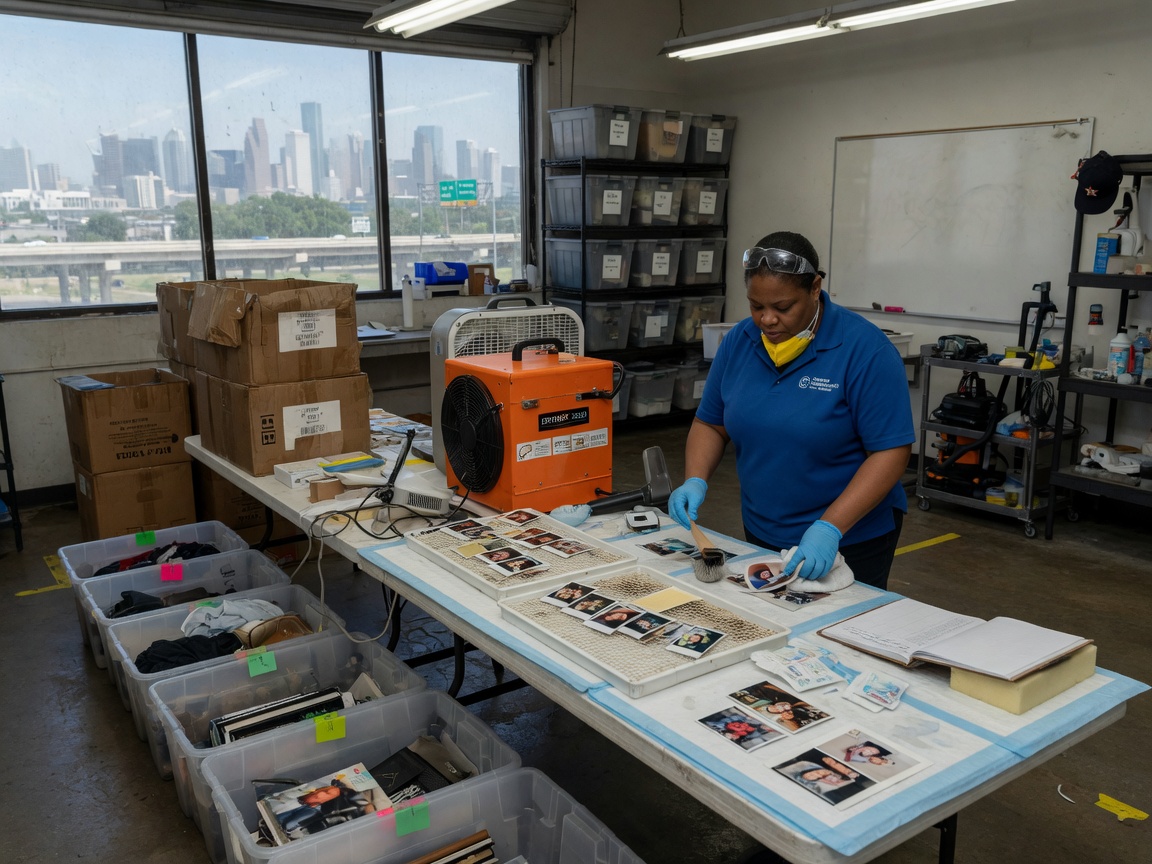
Pearland and Katy homes built on pier-and-beam foundations see appliance leaks travel along joists into closets and linen storage. Paper documents, photographs, and electronics stored on lower shelves are especially vulnerable because the crawlspace humidity feeds upward through floor gaps. On-site teams pack these items in breathable crates, log each piece, and move them to a climate-controlled facility where HEPA air scrubbers run continuously until moisture readings stabilize below 12 percent on wood and 8 percent on paper.
Technician insight
In Houston the thing that catches most people out with Content Drying & Cleaning is how quickly the humidity climbs back into wood and paper once the dehumidifiers are turned off; older Heights and Montrose homes with unsealed crawlspaces keep feeding moisture upward for days after the initial appliance leak is fixed.
Midtown Condo Dishwasher Leak
Water from a failed supply line reached a closet storing photo albums and a cedar chest. We mapped elevated moisture in the cedar and lower album pages, moved the items to the Center Street drying room, and ran low-temperature airflow with desiccants for 72 hours. All albums and the chest returned to the owner with no warping or staining.
Content Drying & Cleaning Services We Offer
✓Furniture Frame Drying
Disassembly, moisture mapping, and controlled drying of wood and upholstered furniture to prevent warping and joint failure after appliance leaks.
✓Textile and Clothing Restoration
Sorting, blotting, and low-heat drying of garments and linens with odor removal for items soaked by washing-machine or water-heater overflows.
✓Document and Photo Drying
Freeze-drying and flattening of paper records, books, and photographs to salvage content damaged in kitchen or laundry room appliance failures.
✓Electronics Content Recovery
Inspection, ultrasonic cleaning, and drying of small electronics and media devices exposed to appliance water in Houston homes.
✓Area Rug and Pad Treatment
Extraction, padding removal, and humidity-controlled drying of rugs affected by leaks from refrigerators or dishwashers on slab foundations.
Content Drying & Cleaning Cost in Houston, TX
| Service | Typical Range | What Affects It |
|---|---|---|
| Small batch (under 10 items) | $250–$450 | Mostly clothing or documents from a single room |
| Medium household contents | $600–$1,100 | Furniture and textiles from kitchen or laundry area |
| Large or mixed load | $1,200–$2,000 | Multiple rooms or heavy rugs plus electronics |
| Facility drying surcharge | $150–$300 | Added when items must leave the property for controlled drying |
Ranges are typical for Houston, TX and confirmed with an exact written quote before any work starts.
How it works
- 1
Inventory and Moisture Mapping
Technicians photograph and tag every item, then use pin and pinless meters to record moisture levels in wood, fabric, and paper before any drying begins.
- 2
Segregation by Material
Contents are separated into porous, semi-porous, and non-porous groups so airflow and dehumidification settings can be matched to each category.
- 3
On-Site or Facility Drying
Smaller loads stay in the home with portable equipment; larger or heavily saturated items move to a controlled drying chamber at the Center Street facility.
- 4
Final Verification and Return
Every piece is re-metered, cleaned if needed, and returned only after readings confirm safe moisture levels for Houston's typical humidity range.
Pricing
Pricing varies by volume, material types, and whether items stay on-site or move to the drying facility.